
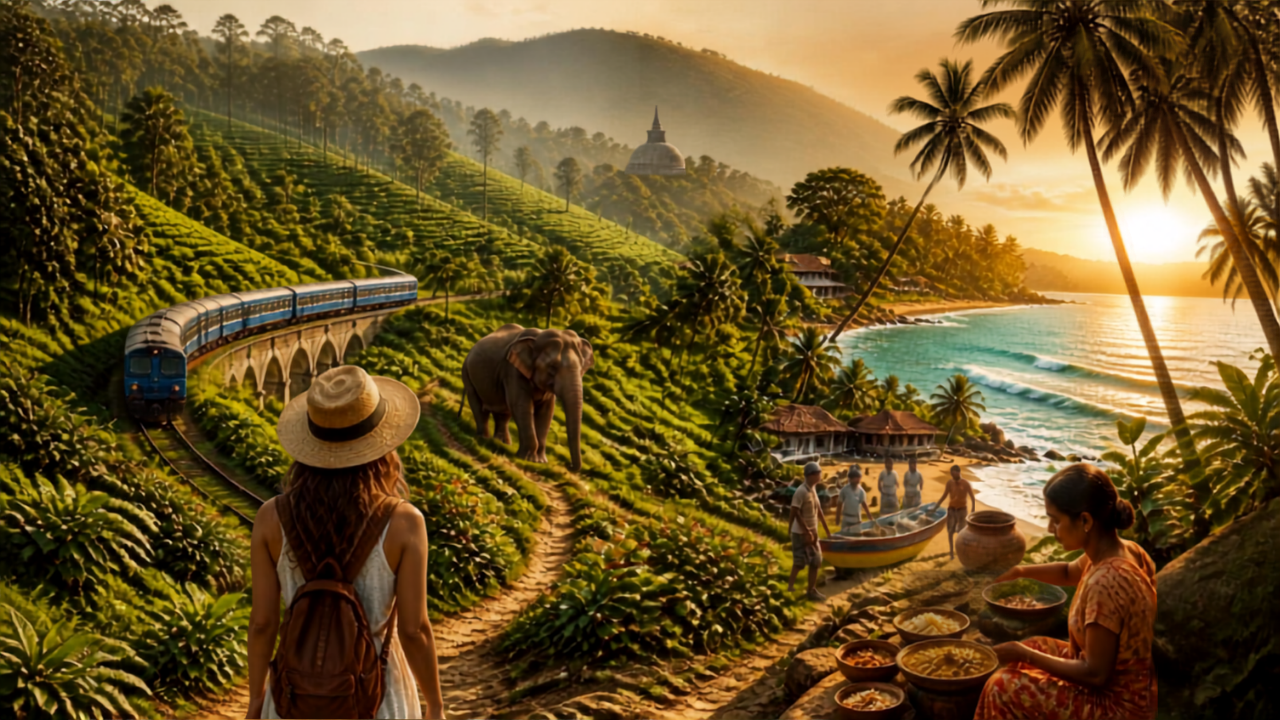

“Sri Lanka Beyond the Guidebooks: What Most Travellers Miss”
Sri Lanka has a way of surprising you.
On the map, it looks like a small island at the southern edge of India. But travel through it and the country feels remarkably varied. In the space of a few days, you can move from an ancient city and dry-zone wilderness to misty tea country, then finish your journey beside the warm waters of the Indian Ocean.
Places such as Sigiriya, Kandy, Ella, Galle and Mirissa deserve their popularity. They are some of the highlights of any first journey through Sri Lanka. But they are only part of the story.
Some of the country’s most memorable experiences are found away from the usual tourist trail: a quiet beach with barely another person in sight, a family-run guesthouse in the mountains, elephants appearing beside a remote reservoir, or a small village where lunch is prepared from ingredients grown just outside the kitchen.
If you want to experience more than Sri Lanka’s headline attractions, these are some of the island’s best-kept travel secrets.
1. Sri Lanka Is Small, but Its History Is Enormous
One of the pleasures of travelling around Sri Lanka is how easily you can move between completely different periods of history.
The country has eight UNESCO World Heritage Sites, ranging from the ancient cities of Anuradhapura and Polonnaruwa to the rock fortress of Sigiriya, the cave temples of Dambulla and the Sacred City of Kandy. Galle Fort tells another chapter of the island’s story, shaped by centuries of European colonial influence.
And Sri Lanka’s heritage isn’t confined to monuments.
You see it in Buddhist temples at sunrise, Hindu kovils filled with colour, colonial-era railway stations, traditional village homes and religious festivals that still bring entire communities together.
Take your time with these places. Sri Lanka’s history becomes far more interesting when it is experienced as part of everyday life rather than simply as a checklist of historic sites.
2. There Isn’t Just One “Best Time” to Visit Sri Lanka
Sri Lanka’s weather is often misunderstood.
Because the island is influenced by two monsoon systems, conditions can be very different from one side of the country to the other. A rainy afternoon in the southwest doesn’t necessarily mean poor weather on the east coast.
Broadly speaking, the south and west coasts tend to be most popular from around December to April, while the east coast comes into its own during the middle months of the year.
That seasonal contrast is actually an advantage.
Instead of asking, “When is Sri Lanka open for travel?”, it is often better to ask, “Which part of Sri Lanka is best right now?”
With a well-planned route, the island can be rewarding throughout much of the year.
3. Yala and Minneriya Aren’t the Only Places to Go on Safari
Yala National Park is famous for good reason, particularly for its leopard population.
And Minneriya Park is more about watching elephants generally; it has more herds within a small space, and people can reach out.
But Sri Lanka’s wildlife experiences extend far beyond Yala and Minneriya.
Wilpattu offers vast landscapes of forest and natural lakes, with opportunities to see elephants, sloth bears, crocodiles and, with some luck, leopards.
Gal Oya provides something quite different: the chance to explore the national park by boat across the Senanayake Samudraya reservoir. Elephants are occasionally seen swimming between islands, while the reservoir attracts an impressive variety of birdlife.
Maduru Oya and Wasgamuwa are excellent choices for travellers who value wilderness and quieter safari experiences. Bundala, meanwhile, is particularly rewarding for birdwatchers.
The secret is not simply choosing the park with the most famous name. Choose according to the season, the wildlife you hope to see and the kind of safari experience you want.
Sometimes a quieter park is the better experience.
4. Some of Sri Lanka’s Best Beaches Are the Ones Without the Crowds
Mirissa, Unawatuna, Bentota and Hikkaduwa are firmly established on Sri Lanka’s beach circuit. Yet the coastline stretches for more than a thousand kilometres, and there are still wonderfully quiet stretches of sand.
Around Tangalle, Kudawella and Nilwella, you’ll find smaller coves and beaches that feel noticeably more peaceful than the country’s major resort areas. Further east, the coastline around Panama offers an altogether wilder atmosphere.
On the northeast coast, areas around Trincomalee combine beautiful beaches with warm seasonal seas, snorkeling and marine experiences.
The appeal of these places isn’t a long list of attractions. Quite the opposite.
You come for the space, the sound of the ocean and the pleasure of having nowhere in particular to be.
5. The Hill Country Goes Far Beyond Ella
Ella is beautiful, but Sri Lanka’s highlands have much more to offer.
The Knuckles Mountain Range is one of the country’s finest regions for walking, with forested ridges, waterfalls, tea country and remote communities scattered through the valleys.
Meemure offers a glimpse of rural mountain life, while places such as Ohiya, Haputale and Belihuloya are excellent alternatives for travellers who want cooler temperatures and slower days.
Then there is Riverston, with sweeping mountain scenery and hiking routes through the central highlands.
These places reward travellers who are willing to slow down. Walk through a village. Stop at a roadside tea shop. Follow a forest trail with a local guide. Spend a night somewhere where the evening soundtrack is insects, birds and the occasional distant waterfall.
That is a very different Sri Lanka from the one seen through a coach window.
6. There Are Waterfalls Everywhere—Not Just at the Famous Viewpoints
Sri Lanka has an extraordinary concentration of waterfalls, particularly across the central highlands.
Bambarakanda, the country’s highest waterfall, is an impressive sight, while Diyaluma has become popular for its dramatic cascades and natural pools. But many smaller falls remain surprisingly peaceful.
Bomburu Ella, Galboda, Dunhinda, Rathna Ella and Lanka Ella are among the waterfalls worth including in a hill-country journey.
Some are easy to reach; others require a proper walk.
And often, the journey is half the experience. Roads wind through tea estates and mountain villages before narrowing into footpaths surrounded by forest.
Wear good shoes, check local conditions after heavy rain and avoid treating natural pools as guaranteed swimming spots. The highlands are beautiful, but the landscape deserves respect.
7. The Famous Train Ride Is Only Part of Sri Lanka’s Railway Story
The train journey through the hill country has become one of Sri Lanka’s signature travel experiences. Photographs of blue trains passing through tea plantations have travelled around the world.
The scenery genuinely is spectacular.
But you don’t necessarily need to spend the entire day travelling from Kandy to Ella to experience it.
Sections around Hatton, Nanu Oya, Haputale, Bandarawela and Ella pass through some of the most beautiful landscapes on the railway. Breaking the journey into shorter stages can also make the experience more comfortable and give you time to explore along the way.
The train is not just transport. It is part of the journey itself.
Open windows, old stations, tea-covered hills and the slow rhythm of railway travel give you a chance to see the country at a completely different pace.
8. Sri Lanka Is Remarkably Good for Marine Experiences
For an island of its size, Sri Lanka offers an impressive range of ocean experiences.
Depending on the season and location, travellers may encounter blue whales, sperm whales, dolphins and sea turtles. There are also opportunities for snorkeling, scuba diving, surfing, kayaking and lagoon trips.
Mirissa is well known for whale-watching excursions, while Kalpitiya has long been associated with dolphin encounters. Trincomalee offers excellent seasonal marine experiences on the east coast, and Pigeon Island is one of the country’s best-known snorkeling locations.
Sri Lanka’s surf scene has also developed considerably, from the southern coast to Arugam Bay in the east.
The important thing is timing. Sea conditions change throughout the year, so the best coast for swimming, diving, surfing or whale watching depends heavily on the season.
9. Sri Lankan Food Is Much More Than “Rice and Curry”
Rice and curry might be the phrase travellers hear most often, but Sri Lankan cuisine is far more varied than that description suggests.
Breakfast might begin with string hoppers and coconut sambol. Later, you could find yourself eating a freshly made hopper with an egg in the middle, a plate of kottu chopped noisily on a hot griddle, or a seafood curry flavoured with coconut, chilli and spices.
Different regions have their own specialties too. Jaffna’s cuisine is known for bold flavours and distinctive curries, while the coastal areas make excellent use of fresh fish and seafood.
Look out for dishes such as lamprais, pittu, ambul thiyal, coconut roti and watalappan.
Better still, try a home-cooked meal.
Some of the most memorable food in Sri Lanka isn’t served in an elegant restaurant. It arrives at a family table, often as several dishes prepared from recipes passed down through generations.
10. Wellness Here Has Roots Much Deeper Than the Modern Spa
Wellness tourism may be fashionable, but Ayurveda has been part of Sri Lankan life for centuries.
Traditional Ayurvedic practices use herbal preparations, massage, diet and lifestyle routines as part of a broader approach to wellbeing. Today, travellers can find everything from simple Ayurvedic treatments to dedicated multi-day wellness retreats.
Yoga and meditation retreats have also become increasingly common, particularly in quieter coastal and hill-country settings.
For travellers interested in wellness, it is worth looking beyond the word “spa.” A genuine Ayurvedic programme is quite different from booking a relaxing massage at a resort, and reputable centres should be clear about the type of treatment they provide.
11. Festivals Can Completely Change the Experience of a Place
Sri Lanka’s calendar is filled with religious and cultural celebrations.
The Kandy Esala Perahera is the best-known, transforming the city with elaborate processions, traditional dancers, drummers and ceremonial events.
Vesak, celebrating important events in the life of the Buddha, brings lanterns and illuminated decorations to streets and homes across the country. Sinhala and Tamil New Year in April has a very different atmosphere, centred around family, food, traditional games and customs.
Poson is particularly significant around Anuradhapura and Mihintale, while Hindu festivals bring their own colour and traditions to communities across the island.
If your journey happens to coincide with a major celebration, don’t treat it simply as an attraction. Learn what the occasion means to the people taking part. It makes the experience far richer.
12. Sri Lanka Has a Serious Adventure Side
Sri Lanka is often marketed around beaches, temples and wildlife, but there is plenty here for travellers who prefer to stay active.
The Knuckles Mountain Range offers some of the country’s best trekking. Kitulgala is known for white-water rafting and rainforest adventures. Cycling can be a wonderful way to explore rural areas and ancient cities, while kayaking opens up lagoons, reservoirs and mangrove environments.
There are also opportunities for surfing, camping, rock climbing, canyoning and other outdoor activities.
And because the landscape changes so quickly, adventure can easily become part of a broader itinerary rather than the entire holiday.
You could hike through the mountains one morning and be heading towards the coast the following day.
13. The Most Memorable Experiences Are Often the Simplest
Perhaps Sri Lanka’s biggest secret isn’t a destination at all.
It might be the conversation you have with a tea seller beside a mountain road. The fruit bought from a small roadside stall. A fisherman explaining the morning’s catch. A family showing you how they prepare a traditional meal.
Sri Lankan hospitality is often warm, informal and wonderfully spontaneous.
Luxury hotels and carefully planned experiences certainly have their place, but leave some room in your itinerary for things that weren’t scheduled.
Those are often the moments people remember.
Discover Sri Lanka Beyond the Postcards
Sri Lanka’s famous attractions deserve to be seen. Climb Sigiriya. Wander through Galle Fort. Take the train through the hill country. Visit an ancient temple and spend a few days beside the Indian Ocean.
But don’t stop there.
Travel a little further into the mountains. Choose a national park you haven’t heard much about. Stay in a small village. Try a dish you can’t pronounce. Wake early enough to see a town before the traffic begins. Spend an afternoon on a beach that doesn’t appear on every “Top 10” list.
The real beauty of Sri Lanka is not that it offers one extraordinary experience. It is how many completely different experiences fit onto one island—and how quickly the landscape, food, culture and atmosphere change as you travel through it.
The famous places may bring you to Sri Lanka.
Very often, it is everything you discover in between that makes you want to return.
0 Comment